Foundation
The core engagement. Two sessions a week, and everything needed to run them arrives with the coach.
$945/mo
2 sessions per week · 45 minutes
- 12-week term
- $2,835 total
What's included

Private in-home training · Portland metro
A twelve-week private engagement, priced accordingly. Two sessions a week, in your home, equipment included.
What it costs
Twelve-week engagements, billed monthly, with the coach, the equipment and the programming all included. Enter your address and each figure below becomes yours — one number per package, not a range.
The core engagement. Two sessions a week, and everything needed to run them arrives with the coach.
$945/mo
2 sessions per week · 45 minutes
What's included
The same training, with the nutrition and travel side built and managed rather than left to you.
$1,345/mo
2 sessions per week · 45 minutes
Everything in Foundation, plus
Only 2 spots open
A third session, longer sessions, and the food handled end to end — shopped for, cooked, and dropped at your sessions.
$2,745/mo+ groceries
3 sessions per week · 60 minutes
Everything in Integrated, plus
Meal prep covers one person; cooking for others is quoted separately. Groceries are billed at cost and are not included in the monthly price.
$150 per month on any tier, and your spouse trains in the same session. The coach is already in the room, which is why it is the cheapest way to add a second person — a couple on Integrated pays $1,495 a month between them, against $2,690 for two separate engagements. It covers training; on Concierge the meal prep is still built for one and a second person is quoted separately.
Settling the twelve weeks in one payment takes 10% off the term — Foundation $2,552 · Integrated $3,632 · Concierge $7,412, groceries separate.
The engagement
Movement screen, body composition, strength markers, and an energy and workload audit — the last of which is really an honest conversation about your calendar. Everything measured here is measured again at week 6 and week 12 under the same conditions. Nothing about the programme gets written until this exists.
The opening training block, built off the screen. The early priority is competence and consistency rather than load — getting the patterns right and getting you to two sessions a week in a life that has beaten every previous attempt at two sessions a week.
The same tests, the same conditions, side by side with week 1. This is where you find out whether the thing is working while there is still time to change it. The block that follows is written against these numbers.
Load and complexity move, because by now the patterns hold. This is the stretch where the change becomes visible to other people — and where the app work on the days between sessions starts deciding how fast it goes.
Full re-test and a written report: every metric, week 1 against week 12, what moved and what did not, and a straight recommendation about what should happen next. You keep the report whether or not you continue.
The other five days
What happens on the other five days does. That is the part every gym membership leaves to you, and it is the part that decides whether week 12 looks different from week 1.
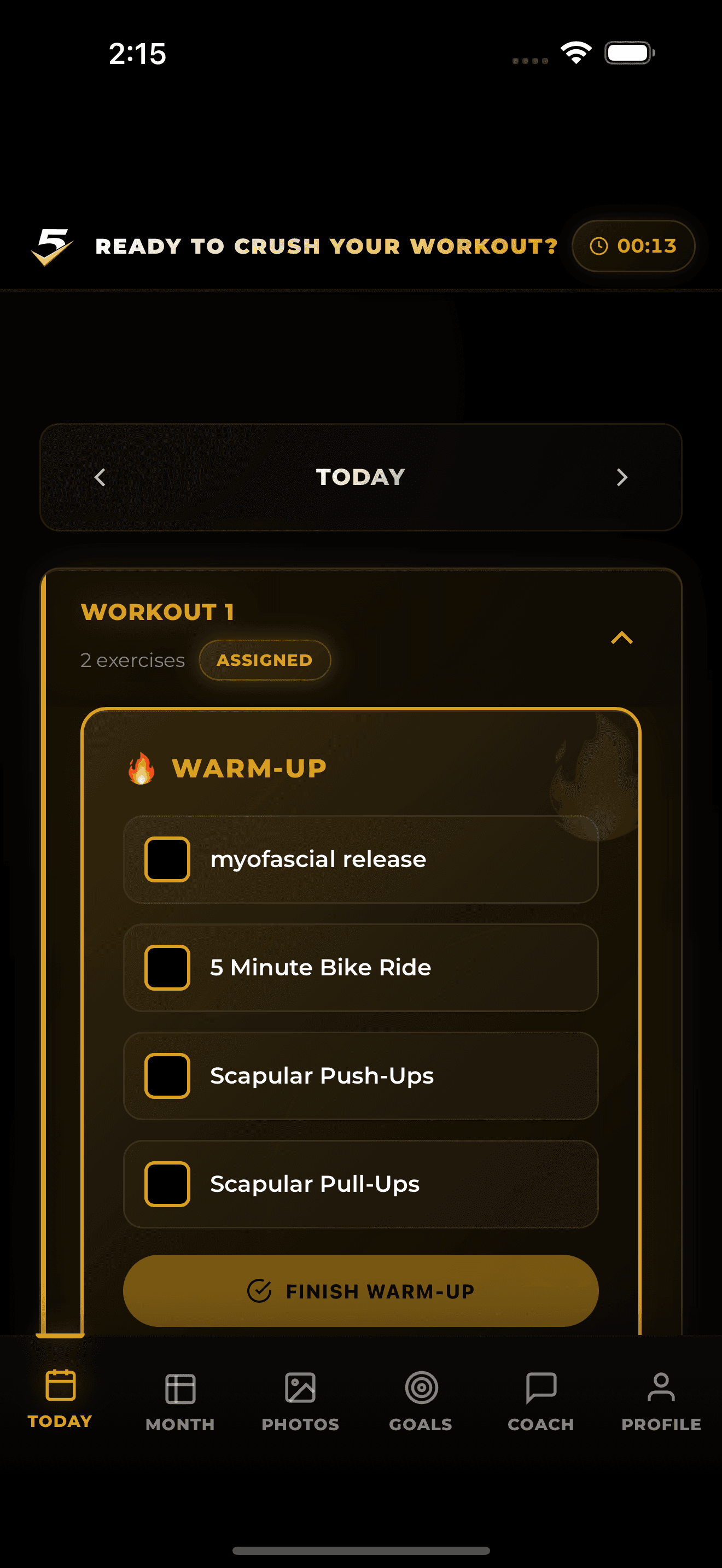
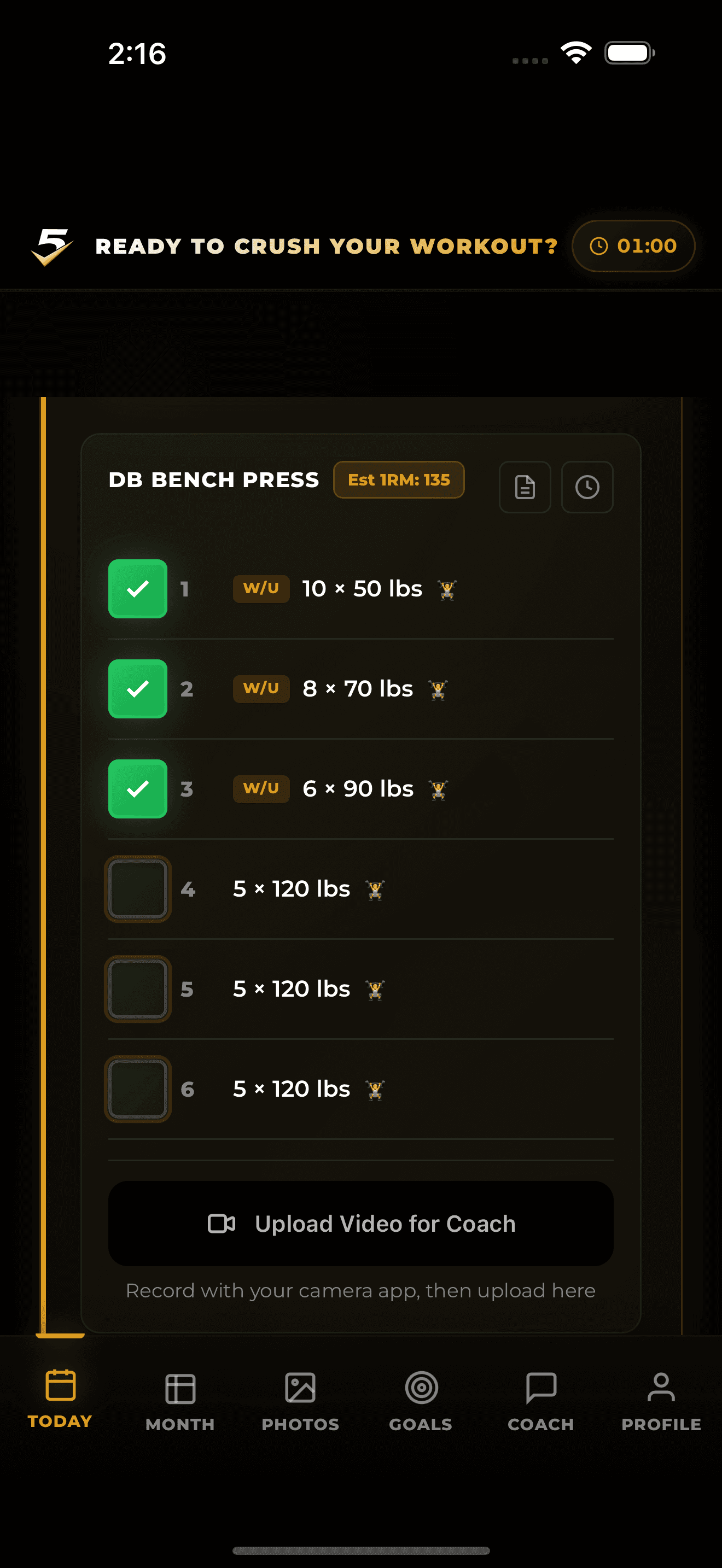
Your programme, your exercise library, and your nutrition tracking live in the Take5 app. I can see it. Not to police you — so that the session on Thursday is written against what actually happened on Tuesday, and so a week where everything fell apart gets a plan rather than a lecture.
The guarantee
Four sessions in, if you want out, you get a full refund for any reason. You do not have to explain it, there is no form, and I will not ask you to sit through a call about it.
Attend 85% of your sessions and hit the nutrition floor we agree on in week 1, and if the week 12 re-test does not show measurable improvement, training continues at no charge until it does.

Who comes to your door
Founder & Head Coach, Take5 Athletics
I coach every one of these sessions myself. That is not a scaling strategy — it is the product. A private in-home engagement is not something you hand to a rotating roster of contractors, and the number of households I can serve this way is limited by how many mornings exist in a week.
Questions
No — it is the normal case, not the exception. Your slot is held for your household, so a session you cannot take is rescheduled rather than forfeited, and twelve hours’ notice is enough. Travel weeks are also where the app carries the load: your programme goes with you, scaled to a hotel gym or to no equipment at all, and I review what you log.
Most sessions run in about the footprint of a rug — a living room, a garage bay, a patio in summer. The equipment comes in with me and leaves with me. If your space genuinely will not work, I will tell you that on the consultation call rather than after you have paid.
None. Everything required arrives with the coach, including the VOLTRA I smart cable system. Some clients eventually buy a piece or two because they want it for the days between sessions, but nothing about the programme depends on you owning anything.
That describes a large share of the people who start. The week 1 screen exists precisely to find what hurts and what does not move well, and the programme is written around it. Where something needs a medical professional rather than a coach, I refer out — I do not train through it.
Yes, and it is the best-value thing on the page. Partner training is $150 a month on any tier and your spouse trains in the same session — the coach is already in the room. A couple on Integrated pays $1,495 a month between them, against $2,690 for two separate engagements. That covers the training — on Concierge the meal prep is built for one person, and feeding a second is quoted separately.
You get the week 12 re-test, the written report, and a straight recommendation. Most people continue on a rolling basis at the same rate; some take the report and run their own training for a while; some come back in the autumn. There is no auto-renewing contract you have to escape from.
Yes. The hardest part of this job is not writing a programme for a deconditioned 50-year-old — it is getting anyone to do two sessions a week for twelve weeks straight. Removing the drive is most of how that problem gets solved, which is the entire reason this service exists.
Coach Tatum Erickson, every session — not a rotating roster and not a subcontractor. See the section above for certifications and background-check details.
Start here
It starts with a fifteen-minute call — your schedule, your training history, and whether this is the right fit. If it is not, I will say so on the call.